Note
Access to this page requires authorization. You can try signing in or changing directories.
Access to this page requires authorization. You can try changing directories.
Switch services using the Version drop-down list. Learn more about navigation.
Applies to: ✅ Azure Data Explorer ✅ Azure Monitor ✅ Microsoft Sentinel
Applies a lag on a series.
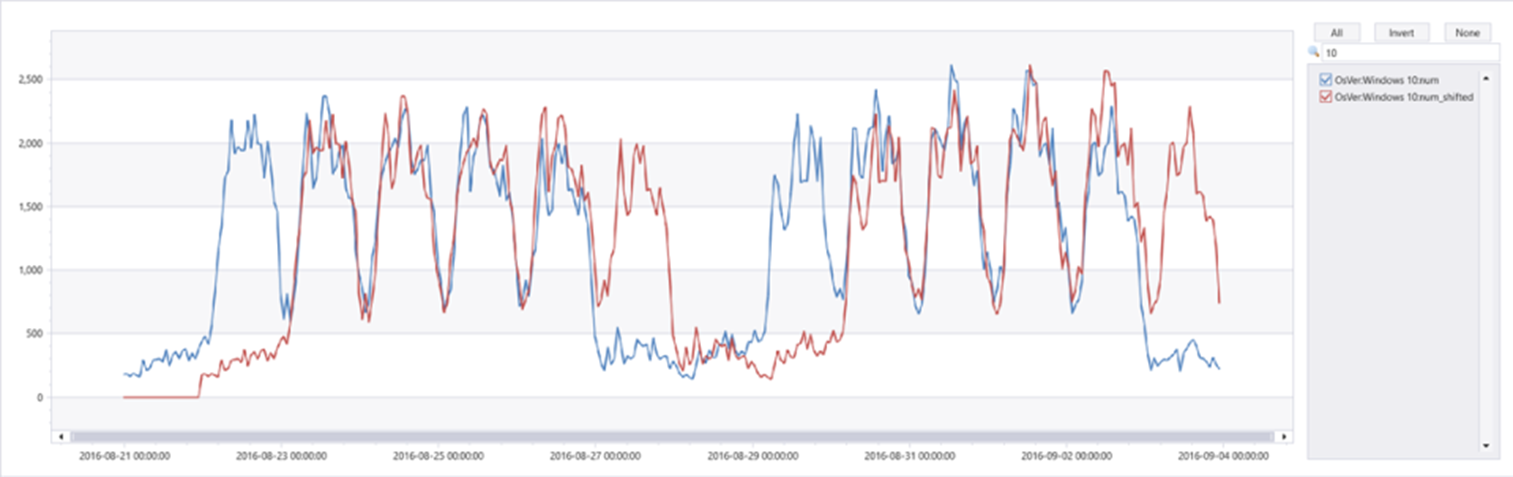
The function series_lag_fl() is a user-defined function (UDF) that takes an expression containing a dynamic numerical array as input and shifts it backward. It's commonly used for shifting time series to test whether a pattern is new or it matches historical data.
Syntax
series_lag_fl(y_series, offset)
Learn more about syntax conventions.
Parameters
| Name | Type | Required | Description |
|---|---|---|---|
| y_series | dynamic |
✔️ | An array cell of numeric values. |
| offset | int |
✔️ | An integer specifying the required offset in bins. |
Function definition
You can define the function by either embedding its code as a query-defined function, or creating it as a stored function in your database, as follows:
Define the function using the following let statement. No permissions are required.
Important
A let statement can't run on its own. It must be followed by a tabular expression statement. To run a working example of series_lag_fl(), see Example.
let series_lag_fl = (series:dynamic, offset:int)
{
    let lag_f = toscalar(range x from 1 to offset+1 step 1
    | project y=iff(x == offset+1, 1, 0)
    | summarize lag_filter = make_list(y));
    fir(series, lag_f, false)
};
// Write your query to use the function here.
Example
To use a query-defined function, invoke it after the embedded function definition.
let series_lag_fl = (series:dynamic, offset:int)
{
    let lag_f = toscalar(range x from 1 to offset+1 step 1
    | project y=iff(x == offset+1, 1, 0)
    | summarize lag_filter = make_list(y));
    fir(series, lag_f, false)
};
let dt = 1h;
let time_shift = 1d;
let bins_shift = toint(time_shift/dt);
demo_make_series1
| make-series num=count() on TimeStamp step dt by OsVer
| extend num_shifted=series_lag_fl(num, bins_shift)
| render timechart
Output