Note
Access to this page requires authorization. You can try signing in or changing directories.
Access to this page requires authorization. You can try changing directories.
Switch services using the Version drop-down list. Learn more about navigation.
Applies to: ✅ Azure Data Explorer ✅ Azure Monitor ✅ Microsoft Sentinel
Calculates a point on a line or a multiline, which is closest to a given point on Earth.
Syntax
geo_closest_point_on_line(longitude,latitude,lineString)
Learn more about syntax conventions.
Parameters
| Name | Type | Required | Description |
|---|---|---|---|
| longitude | real |
✔️ | The geospatial coordinate longitude value in degrees. A valid value is in the range [-180, +180]. |
| latitude | real |
✔️ | The geospatial coordinate latitude value in degrees. A valid value is in the range [-90, +90]. |
| lineString | dynamic |
✔️ | A line or multiline in the GeoJSON format. |
Returns
A point in GeoJSON Format and of a dynamic data type on a line or multiline which is the closest to a given point on Earth. If the coordinate or lineString are invalid, the query produces a null result.
Note
- The geospatial coordinates are interpreted as represented by the WGS-84 coordinate reference system.
- The geodetic datum used to measure distance on Earth is a sphere. Line edges are geodesics on the sphere.
- If input line edges are straight cartesian lines, consider using geo_line_densify() in order to convert planar edges to geodesics.
- In order to calculate a distance between the closest point on a line or multiline to a given point, use geo_distance_point_to_line()
LineString definition and constraints
dynamic({"type": "LineString","coordinates": [[lng_1,lat_1], [lng_2,lat_2],..., [lng_N,lat_N]]})
dynamic({"type": "MultiLineString","coordinates": [[line_1, line_2, ..., line_N]]})
- LineString coordinates array must contain at least two entries.
- Coordinates [longitude, latitude] must be valid where longitude is a real number in the range [-180, +180] and latitude is a real number in the range [-90, +90].
- Edge length must be less than 180 degrees. The shortest edge between the two vertices is chosen.
Tip
- Using literal LineString or a MultiLineString may result in better performance.
Examples
The following example finds the point on a road which is the closest to North Las Vegas Airport.
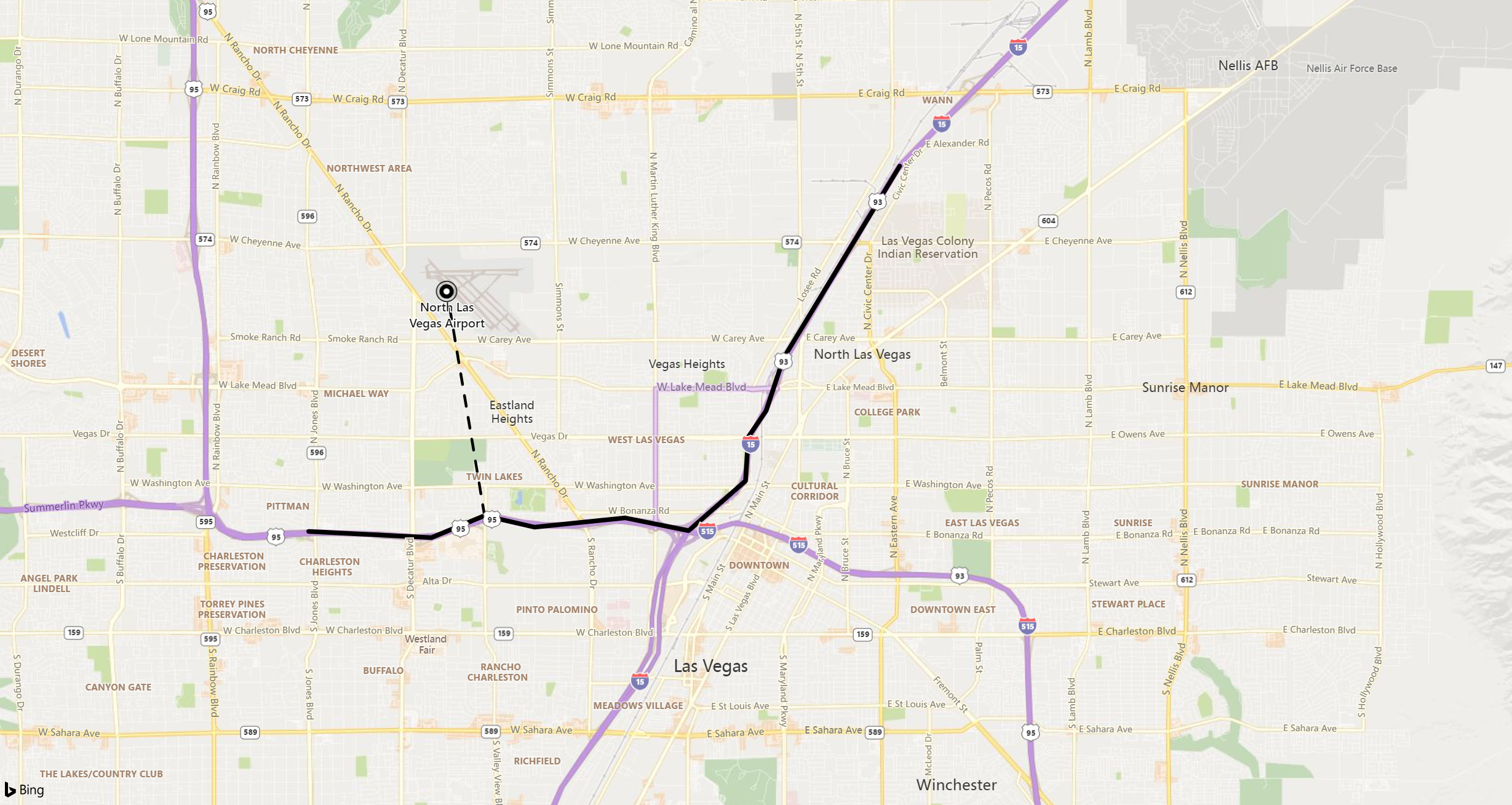
print point_on_line = geo_closest_point_on_line(-115.199625, 36.210419, dynamic({ "type":"LineString","coordinates":[[-115.115385,36.229195],[-115.136995,36.200366],[-115.140252,36.192470],[-115.143558,36.188523],[-115.144076,36.181954],[-115.154662,36.174483],[-115.166431,36.176388],[-115.183289,36.175007],[-115.192612,36.176736],[-115.202485,36.173439],[-115.225355,36.174365]]}))
Output
| point_on_line |
|---|
| { "type": "Point", "coordinates": [ -115.192612, 36.176736]} |
The following example returns a null result because of the invalid LineString input.
print isnull(geo_closest_point_on_line(1,1, dynamic({ "type":"LineString"})))
Output
| result |
|---|
| true |
The following example returns a null result because of the invalid coordinate input.
print result = isnull(geo_closest_point_on_line(300, 3, dynamic({ "type":"LineString","coordinates":[[1,1],[2,2]]})))
Output
| result |
|---|
| true |