Note
Access to this page requires authorization. You can try signing in or changing directories.
Access to this page requires authorization. You can try changing directories.
This article describes how to enable system‑assigned and user‑assigned managed identities with a vault so Azure Backup can authenticate to dependent Azure resources without storing credentials. The vault uses a managed identity, which acts as a Microsoft Entra ID service principal, and you grant it Azure role‑based access control (Azure RBAC) permissions on target resources such as protected data sources and Azure Key Vault encryption keys.
Azure Backup uses this identity to obtain Microsoft Entra tokens at runtime, eliminating credential handling while enabling secure access at no extra cost. The article also explains when to use each identity type and how their lifecycle and assignment differ.
Supported managed identity types
Azure Backup supports system-assigned and user-assigned managed identities. You can enable both managed identity types on the same vault at the same time.
| Managed identity type | Consideration |
|---|---|
| System-assigned |
Note that the system-assigned identity has the same name as the vault. Use the object ID from the Identity blade for automation. |
| User-assigned |
|
Key differences between system-assigned and user-assigned managed identities
The following table provides a comparison summary of system-assigned and user-assigned managed identities.
| Consideration | System-assigned | User-assigned |
|---|---|---|
| Lifecycle | Tied to the vault; deleted with it | Independent; persists across vault changes |
| Cardinality | One per vault | Many per vault; sharable across vaults |
| Typical use case | Single-vault deployments, simplest setup | Fleet deployments, standardized RBAC, pre-provisioned identities |
| Enable at vault creation | Not supported; enable after the vault is created | Supported on Backup vault at creation |
Prerequisites
Before you enable managed identities for the vault, review the following prerequisites:
- Check that a vault exists, or permission to create one.
- Verify that your account has the Backup Contributor role (or equivalent) on the vault to manage identity and assign roles.
- Identify the resource group of each downstream resource (disk, storage account, key vault, and so on) to scope role assignments correctly.
Enable managed identity
You can enable managed identities for a Recovery Services vault using the Azure portal, Azure CLI, or PowerShell.
Choose a client:
To enable managed identities for a Recovery Services vault using the Azure portal, follow these steps:
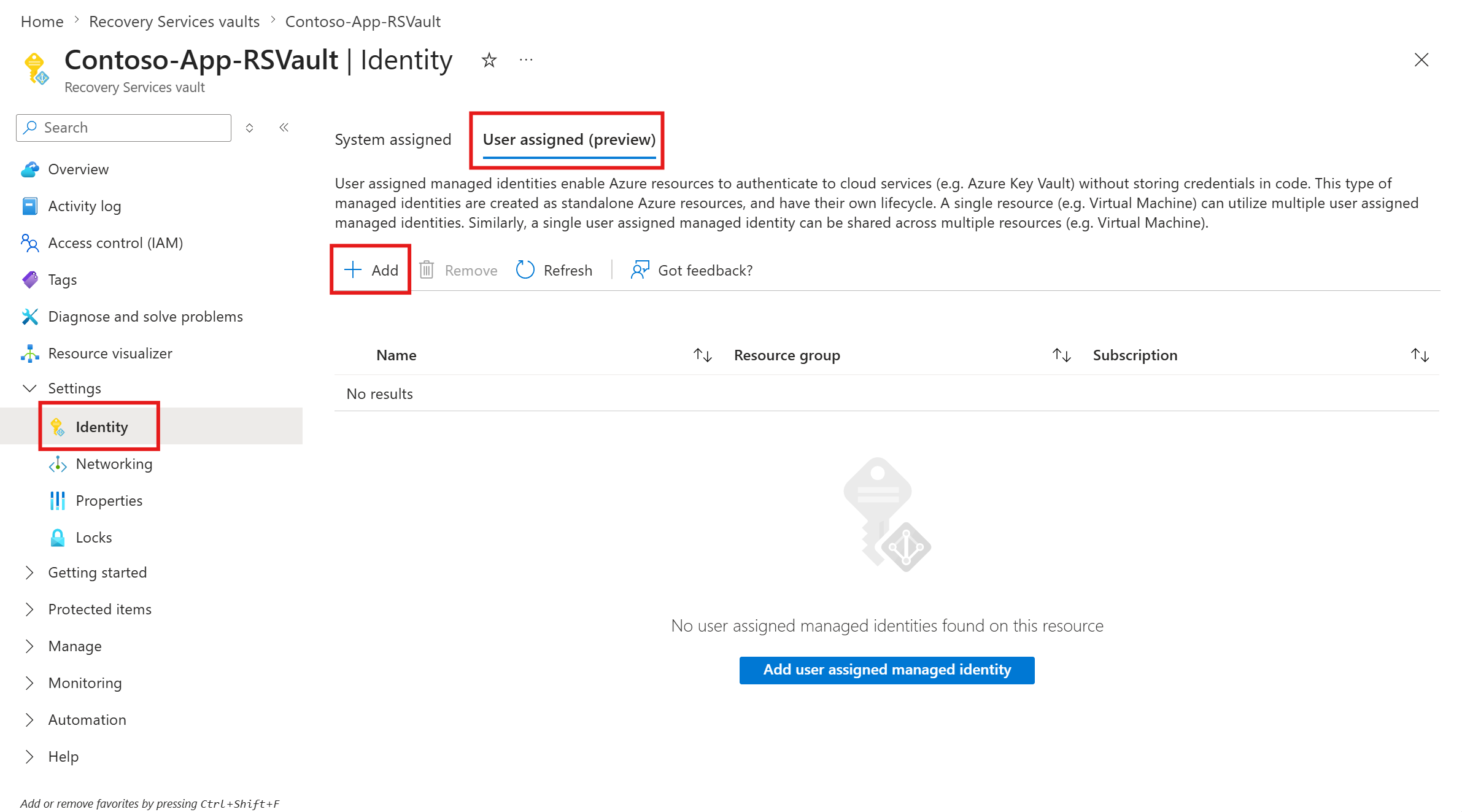
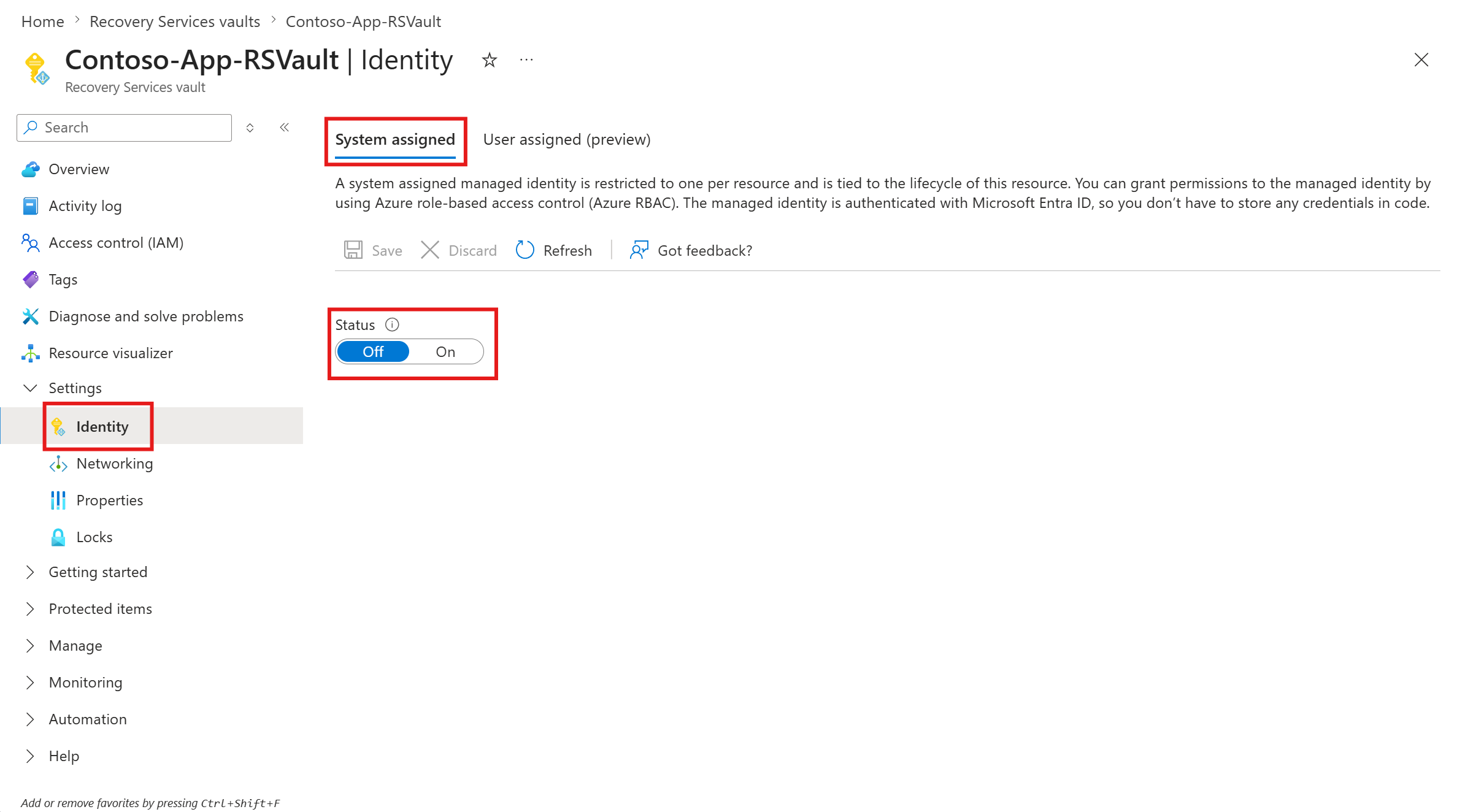
Go to your Recovery Services vault and select Settings > Identity
On the Identity pane, for a system-assigned identity, select the System assigned tab, set Status to On, and select Save
For a user-assigned identity, select the User assigned tab, select + Add, choose the subscription and identity, and select Add